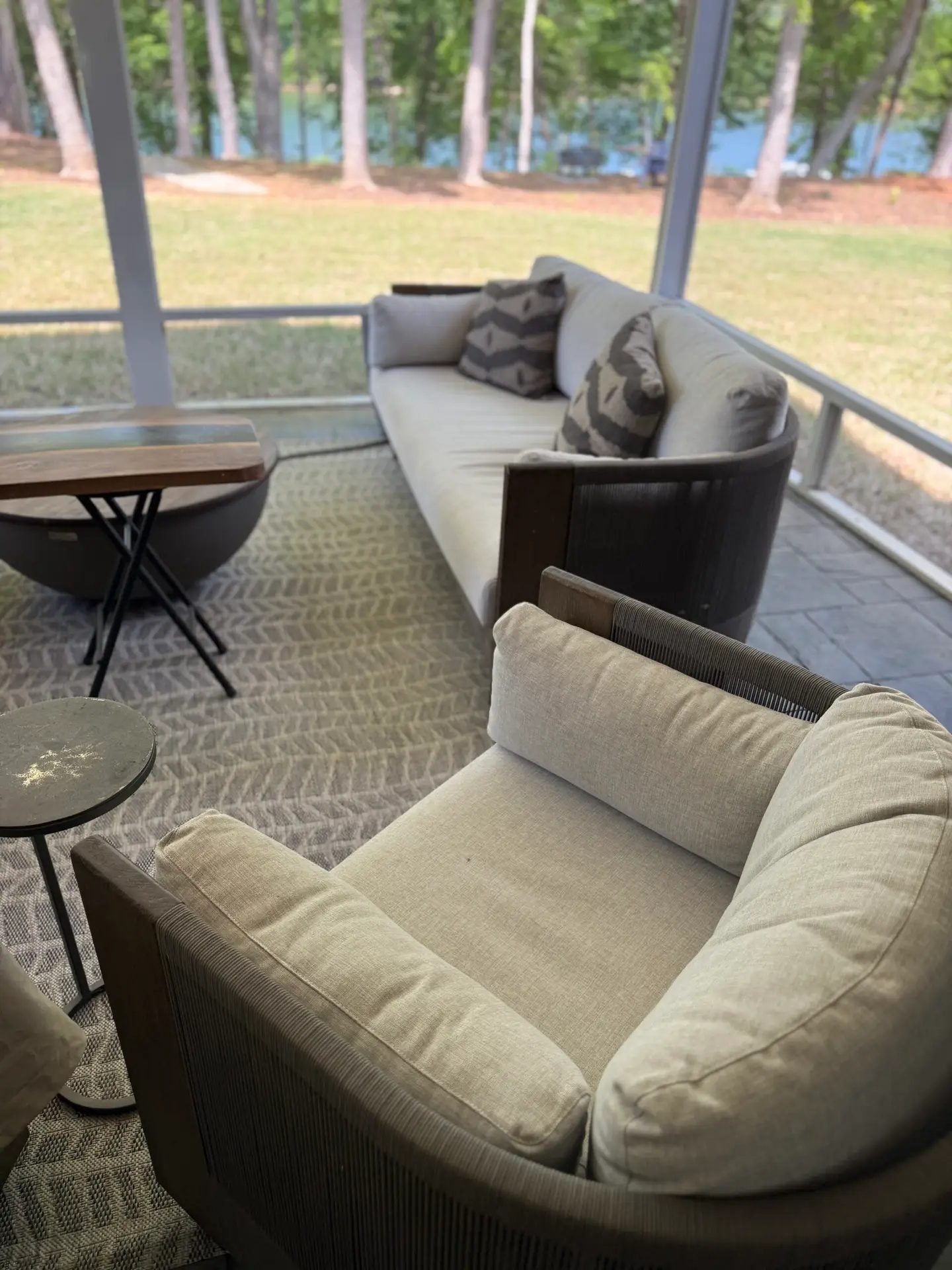
Charlotte's normal July high is 90.3°F, per the National Weather Service, and a porch only earns its keep in August if the air moves. A screened porch ceiling fan, lights on a dimmer and a couple of well-placed outlets turn the porch into a room you use after dark. Express Sunrooms of the Carolinas has planned fans and lighting into Charlotte porches since 1995. This page covers damp and wet ratings, sizing a fan to the floor, lighting layouts, GFCI outlets, the electrical code and the county permit.

Every fan and light fixture carries a listing for the location it was tested for. On a porch, that label matters more than the style.
UL's luminaire marking guide defines a damp location as an exterior or interior spot normally or periodically subject to condensation, including partially protected locations. A wet location is one where water may drip, splash or flow on or against the equipment. IAEI Magazine, written for electrical inspectors, notes that open covered porches can count as damp locations, especially in humid regions.
| Listing | What it means | On a screened porch |
|---|---|---|
| Dry | Indoor spaces not normally subject to dampness. | Not for a porch. Humidity alone will shorten its life. |
| Damp | Condensation and moisture, but no direct water. | The middle of the ceiling under a deep roof, well back from the screen walls. |
| Wet | Water may drip, splash or flow onto it. | Near the screen walls, beside the door, or anywhere blowing rain reaches. |
Definitions from UL's Luminaires Marking and Application Guide. Porch guidance is general; the inspector has the final say on your location.
Screen mesh slows rain but does not stop it, and Charlotte summer storms push it sideways. ENERGY STAR advises a UL damp rating for humid areas and a UL wet rating for fans that may come in direct contact with water, such as on a patio or porch. On a narrow porch, or one with a shallow overhang, we lean to wet-rated fans and fixtures. On a deep porch with the fan centered far from the mesh, damp can be fine.
ENERGY STAR publishes blade-span guidance by room size. A porch is measured the same way: length times width of the floor.
| Floor area | Suggested blade span |
|---|---|
| Up to 75 sq ft | 29 to 36 inches |
| 76 to 144 sq ft | 36 to 42 inches |
| 144 to 225 sq ft | 44 inches |
| 225 to 400 sq ft | 50 to 54 inches |
Source: ENERGY STAR Ceiling Fan Basics, checked November 2026.
ENERGY STAR says to mount a fan in the middle of the room, at least 7 feet above the floor and 18 inches from the walls, and 8 to 9 feet up where the ceiling allows. On a vaulted porch ceiling, a downrod brings the blades into that range.
A 12 x 16 foot porch is 192 sq ft, which lands in the 44 inch row. A 14 x 24 foot porch is 336 sq ft, in the 50 to 54 inch row; on a long, narrow porch, two smaller fans, each over its own seating area, often feel better than one. These are illustrations from the published table, not a design.

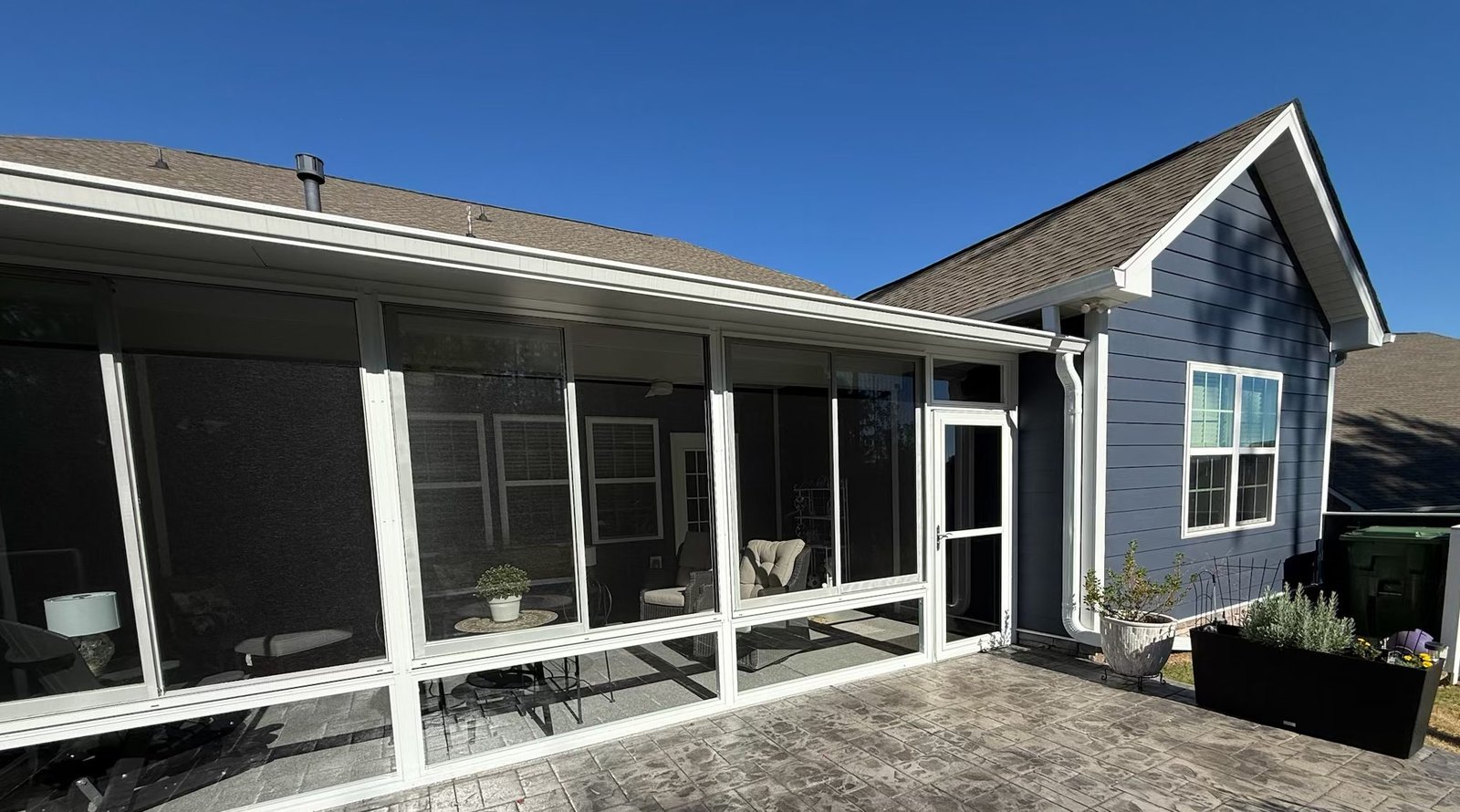
Good porch light comes in layers, each on its own switch, so you can go from supper to a late conversation without everyone squinting.
A light kit on the fan, or a fixture where the fan is not. On a dimmer, it is the one most people use.
Flush or recessed lights spaced along a long porch. Near the screen, they should carry a wet listing.
One by the house door and one by the screen door, so nobody fumbles for the latch.
Low lights on the stairs down to the yard. The edge of the last step is easy to miss at night.
Fan, center light and edge lights on separate switches, placed by the door so the porch is lit before anyone walks out.
Outdoor-rated string lights or lamps on a protected outlet add warmth without more wiring.
Plan screened porch lighting before the ceiling boards go up. Boxes, wire runs and the fan support are far easier to place in an open ceiling than to fish in later.

Under the National Electrical Code, section 210.8(A)(3), receptacles outdoors at a dwelling must have ground-fault (GFCI) protection, as the Electrical Safety Foundation (ESFI) notes in its NEC summary. A GFCI cuts power in a fraction of a second when current leaks to ground, which on a damp porch is the point.
Where an outlet sits in a wet location, the NC State Electrical Division has written that 15 and 20 amp receptacles need an enclosure that stays weatherproof whether or not a plug is inserted. That is the deeper in-use cover you see on outdoor outlets.
North Carolina adopts the National Electrical Code, with state amendments, as its State Electrical Code. Which edition applies to a house is less obvious.
For a homeowner, the practical upshot is simple: the porch wiring is designed to the edition the inspector enforces, and the inspection confirms it.
Mecklenburg County's home improvement permit guidance names ceiling fans and new light fixtures in its list of typical permit projects, treats electrical work as a general permit trigger, and notes that permits are issued to the person doing the work. On a new porch, the wiring is permitted and inspected along with the build. Adding a fan to a porch you already have is its own electrical job, and we confirm the scope with the county. See the screened porch permits guide.
On a new build, wire runs go in before the ceiling is closed. On an existing porch, wire is fished through the space above the ceiling where there is access, or run in surface conduit painted to match. Either way, a fan hangs from a ceiling box listed to carry one, never a plain light box.
A well-sized screened porch ceiling fan with the right listing, plus lights and outlets planned before the ceiling goes up, makes the porch usable through a Charlotte summer. Call (704) 713-7151 or send the form. More on the Express Sunrooms screen porch page.
Fans, lights and outlets are added to the porch price. These are the published figures for the porch itself.
Screen walls under a roof and on a floor you already have.
Sources: This Old House (Angi data), Inch CalculatorFootings, floor, roof and screen walls built from scratch.
Source: Inch CalculatorA Charlotte-area builder's published range for screened porches.
Source: Green Exterior RemodelingPublished ranges, not Express Sunrooms pricing. We measure your porch and give you a written price for free. See the full Charlotte screened porch cost guide.
Tell us about the space. We come out, measure, show you options and leave a written price. There is no charge and no pressure to sign.
ENERGY STAR suggests 44 inch blades for 144 to 225 square feet and 50 to 54 inches for 225 to 400 square feet, with smaller fans for smaller rooms. Measure the porch floor. Long, narrow porches often do better with two fans.
ENERGY STAR advises a UL wet rating for fans that may come in direct contact with water, such as on a porch. A damp rating can suit the center of a deep, covered porch, well away from the screen walls where blowing rain reaches.
ENERGY STAR says at least 7 feet above the floor and 18 inches from the walls, ideally 8 to 9 feet where the ceiling allows. A downrod brings a fan down from a tall or vaulted ceiling.
Outdoor receptacles at a home need GFCI protection under NEC section 210.8(A)(3). Outlets in wet locations also need an in-use cover that stays weatherproof with a plug inserted.
Mecklenburg County lists new ceiling fans and light fixtures among typical permit projects, and electrical work generally needs a permit. We confirm the scope with the county and the wiring is inspected.
The NC Office of State Fire Marshal says one- and two-family dwellings are regulated by the 2017 State Electrical Code, based on the 2017 NEC, while the 2020 code covers most other buildings. The 2023 code is on an indefinite delay.
Only one listed for outdoor or damp use, on a suitable outlet, with the manufacturer's clearances kept. Avoid unrated heaters, and keep grills and fire pits out from under the porch roof.
Call the Charlotte office or send the form. We will measure your space and leave you a written price.